French Recipes
Savory Baked Custard
Last updated: September 29, 2026
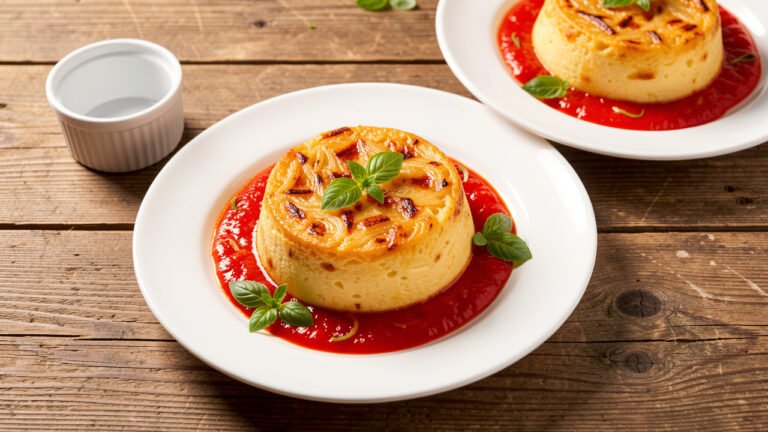
Three things have to land here, and only one of them is hard. The onions need real time on the heat, the custard needs a water bath, and the tomato sauce needs to stay bright and almost raw so it pushes back against all that cream. Get those right and you have a bistro starter that looks far more difficult than it is.
Why These Warm Onion Flans Work
A savory flan is a custard, which means the whole dish is really one ratio: egg to dairy. Too many eggs and it turns rubbery and tastes like a bite of scrambled egg. Too few and it will never hold its shape when you turn it out. Two whole eggs plus two extra yolks to about 1 1/4 cups of cream and milk lands in the narrow band where it sets firmly enough to unmold and still feels like a spoonful of silk.
The yolks are doing quiet work there. Yolk proteins set at a lower temperature and give a softer, richer curd, while whites are what make a custard bouncy and tough when there are too many of them. Swapping one whole egg for two yolks is the classic way to buy richness without buying rubber.
Then there is the flavor logic. Slow-cooked onions taste sweet, almost jammy, and cream flattens everything into one gentle note. Left alone, that gets boring by the third bite. The tomato sauce is the fix: acidic, fresh, barely cooked, and cold enough in character to reset your palate every time you cut through the custard.
It is also a dish that rewards planning. The onions and the sauce can both be made a day ahead, which leaves you with about ten minutes of work and thirty-five minutes of baking on the day you serve it.
Pro observation: Strain the custard base through a fine sieve before it goes into the ramekins. It takes twenty seconds and catches the stringy chalaza from the eggs, which is the difference between silky and slightly lumpy.
Ingredients
Kitchen Measurement Converter
Quickly convert between common cooking measurements without leaving the recipe. Pick a category, enter a value, and the result updates instantly.
Ingredient Notes & Substitutions
Onions
Plain yellow onions are the right choice. Sweet varieties like Vidalia caramelize faster but can turn cloying once the cream joins them. Red onions go a dull gray-purple in a pale custard.
Cream and Milk
Heavy cream cut with whole milk gives body without heaviness. All cream sets into something closer to a rich terrine. Skip skim milk entirely; there is not enough fat to carry the onion flavor.
Eggs
Use large eggs at room temperature. Cold eggs cool the base and lengthen the bake, and the extra yolks are what keep the texture soft rather than springy. Do not substitute whole eggs for the yolks.
Tomatoes
Ripe, fragrant summer tomatoes are worth waiting for, since the sauce is barely cooked and cannot hide a bland one. Out of season, use good canned whole tomatoes and warm them briefly instead.
Equipment
- Four 6-oz ramekins
- Deep roasting pan
- Wide heavy skillet
- Fine mesh sieve
- Whisk and measuring jug
- Kettle of hot water
Before You Start
1. Give the onions their time. Do not start this recipe with thirty minutes on the clock. The caramelizing stage alone runs 35 to 45 minutes and it cannot be hurried.
2. Butter the ramekins generously. Get the butter right up over the rim. A dry patch is exactly where the flan will grip and tear when you unmold it.
3. Boil the kettle early. The water for the bain-marie must go into the pan hot. Cold water drops the oven temperature and adds fifteen unpredictable minutes.
Step-by-Step Instructions
Slice and Start the Onions
Peel the onions and slice them thin, root to tip rather than across, so the pieces hold together instead of dissolving. Melt the butter with the olive oil in a wide skillet over medium heat, add the onions and the salt, and stir to coat. The salt pulls water out immediately, which is what you want at this stage.
Caramelize Low and Slow
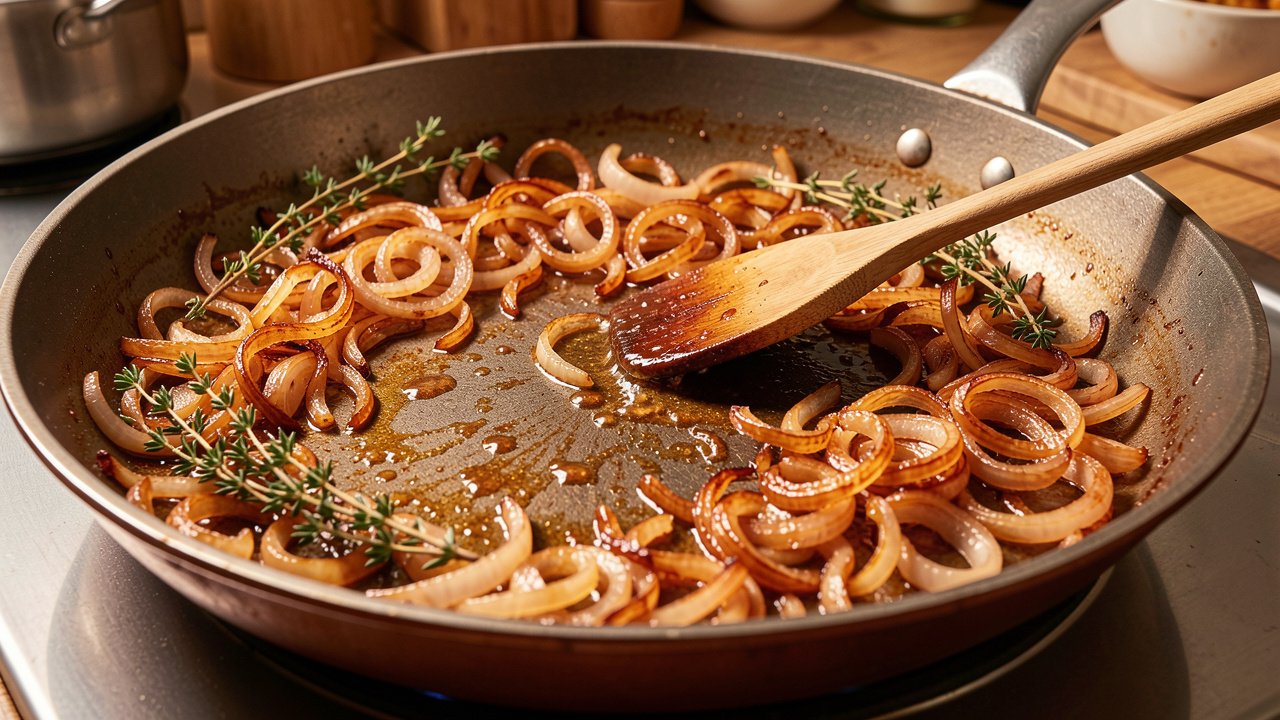
Turn the heat to medium-low and settle in for 35 to 45 minutes, stirring every few minutes. This is not the ten-minute version you see in weeknight recipes; that one gives you soft brown onions that still taste sharp. Real caramelization needs the onions to shed their water first, then hold at a temperature where their natural sugars break down and brown. That browning is where the deep, almost sweet flavor comes from, and it is the only flavor loud enough to survive being surrounded by cream. Add the thyme near the end, then deglaze with the water and scrape up every brown fleck. You want a jammy, coppery mass that has reduced by roughly three quarters. Cool it for ten minutes before it meets the eggs.
Make the Fresh Tomato Sauce
Score the tomatoes, drop them in boiling water for 30 seconds, then into cold water and slip off the skins. Chop them roughly. Warm the olive oil with the smashed garlic clove for one minute, just until it smells sweet, then pull the garlic out and add the tomatoes, salt, and sugar. Cook 6 to 8 minutes only, until they slump but still look red and lively rather than brick colored. Stir in the vinegar and torn basil off the heat, and taste. It should be noticeably sharp on its own; the custard will soften it.
Build the Custard
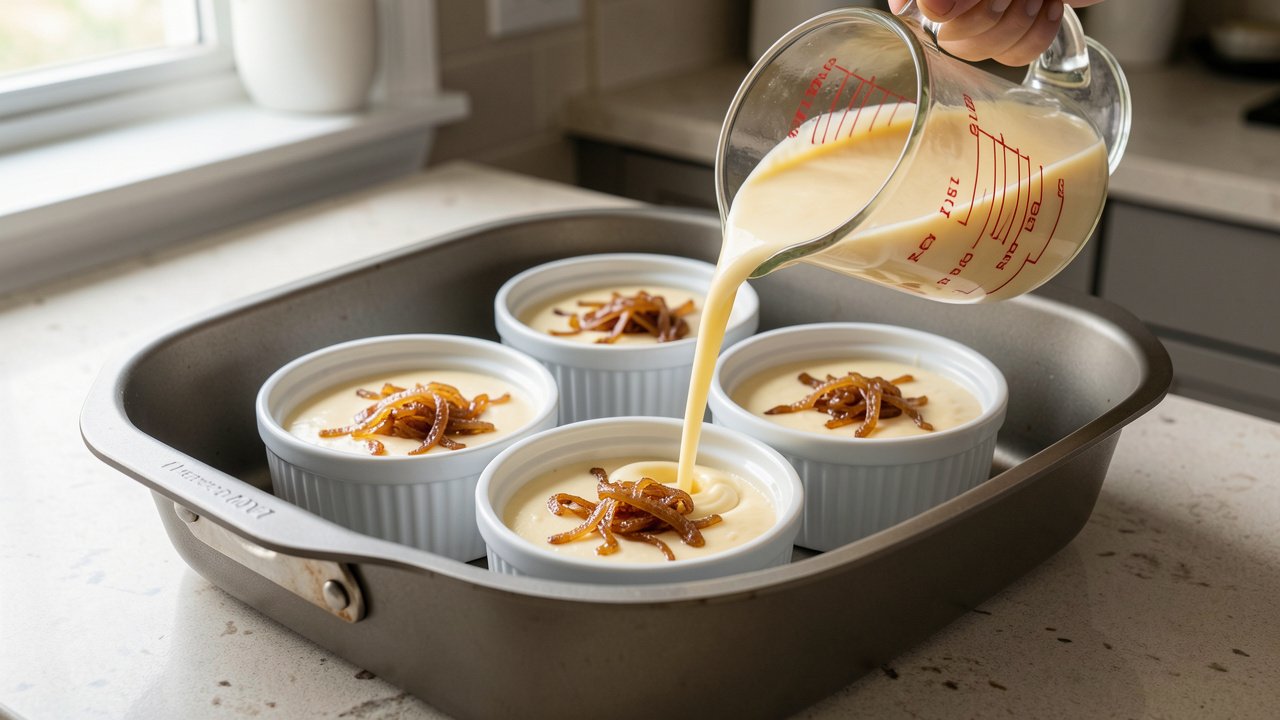
Heat the oven to 325 F. Whisk the eggs and yolks just until blended, without whipping air into them, then whisk in the cream, milk, Parmesan, nutmeg, and pepper. Fold in the cooled onions. Pour the mixture through a fine sieve into a jug, pushing the onions through with a spoon, then stir the caught onion back in so it stays distributed. Divide between four buttered ramekins, filling them to about a quarter inch below the rim.
Bake in a Bain-Marie
Stand the ramekins in a deep roasting pan, ideally on a folded kitchen towel, and pour hot water into the pan until it reaches halfway up their sides. This water bath is not optional. Egg custard sets somewhere around 175 to 180 F, and above roughly 185 F the proteins tighten and squeeze out the liquid they were holding. In a dry oven at 325 F the outer half inch of each flan races past that point long before the center gets there, so you end up with curdled, weeping edges around a runny middle. Water cannot go above 212 F, so it caps the heat reaching the ramekin walls and lets the whole custard climb slowly and evenly. Bake 30 to 35 minutes.
Rest, Unmold, and Serve
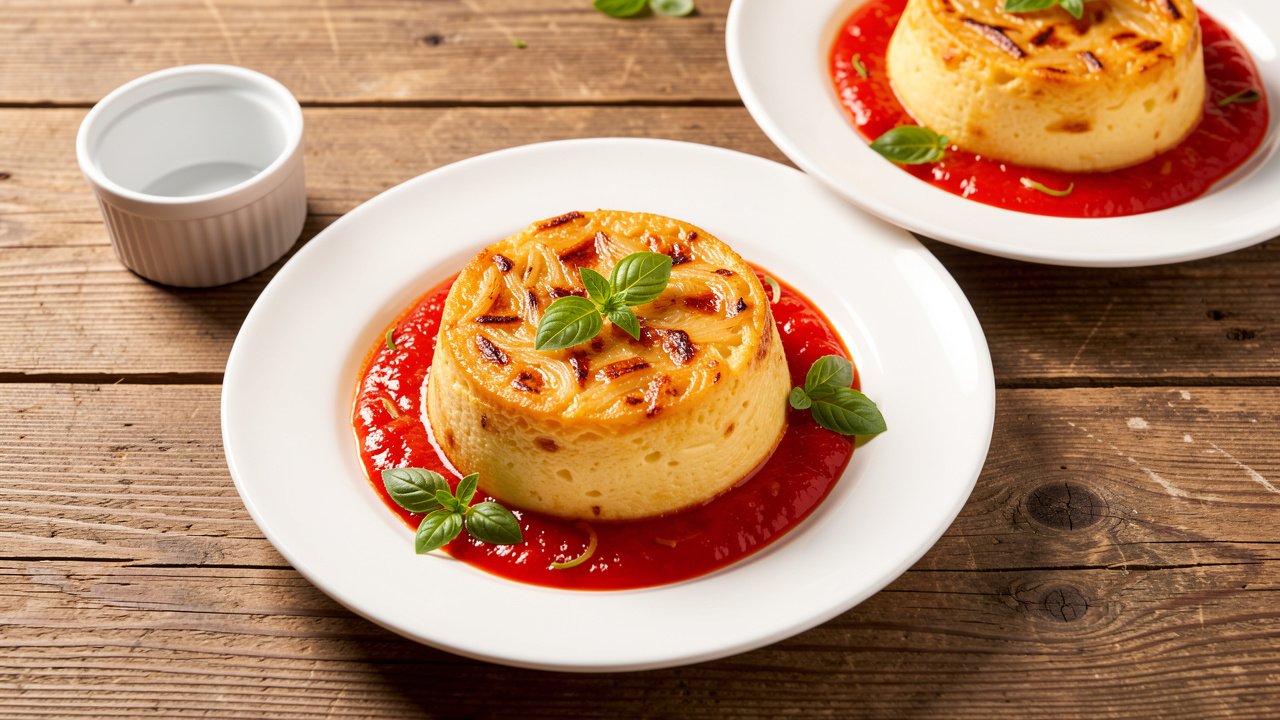
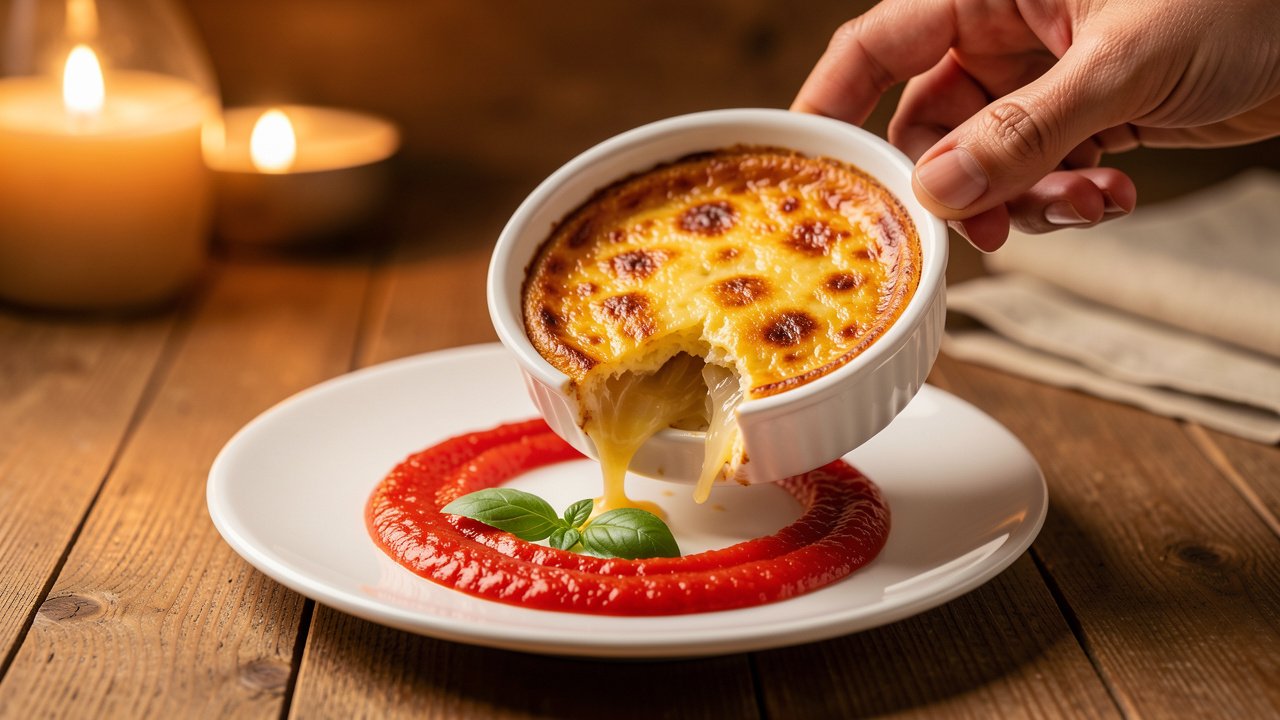
They are done when the edges are set and the center still wobbles like loose jelly when you nudge the ramekin. It will look underdone. Trust it, because carryover heat finishes the job during the rest. Lift them out of the water and rest 10 minutes on a rack, then run a thin knife around the inside edge, press it lightly toward the flan, and invert onto a warm plate. Spoon the tomato sauce around, not over, and finish with basil.
Chef’s Tips From Real Kitchen Testing
If the onions stick and threaten to scorch, add a tablespoon of water and scrape rather than lowering the heat. Dropping the heat stalls the browning; the water lifts the fond back into the onions.
Check the flans at 28 minutes and then every three. The window between wobbly and overset is about five minutes, and it closes faster in ceramic ramekins than in glass.
Warm the plates. A cold plate pulls heat out of the flan in seconds and the tomato sauce turns dull and gluey around the edges of the pool.
Recipe Variations
Serving Suggestions
- A first course before roast chicken or lamb
- Peppery arugula dressed with lemon only
- Thin toasted baguette for the leftover sauce
- A chilled dry white or a light red
Nutrition Facts
Values are estimates for one flan with sauce and vary with your cream and cheese.
Make-Ahead Tips
Both components hold well separately. Caramelize the onions up to three days ahead and refrigerate them in a covered jar; the flavor actually rounds out. The tomato sauce is best made the same day but survives overnight, though hold the basil until serving so it does not blacken. Do not mix the custard base in advance, since the eggs and cream begin to separate and the Parmesan settles into a paste at the bottom of the jug.
Storage, Freezing & Reheating
Common Mistakes to Avoid
Troubleshooting
Flan will not release? Rest it another five minutes, then run the knife deeper and give the inverted ramekin one firm downward jolt. Warming the base briefly on a towel dampened with hot water also helps.
Surface pitted with tiny holes? That is overbaking. The proteins have contracted and pushed out liquid. Pull them earlier next time and lower the oven by 25 degrees.
Tastes of egg rather than onion? The onions were undercooked, so their flavor never got concentrated enough to carry. Go the full 45 minutes.
A Note on Savory Flans
In France, flan simply means a set custard, and the savory version has been bistro standard for generations, appearing as flan de legumes made with whatever the season offers. Pairing one with raw or barely cooked tomato is a southern habit, where acidity is treated as an ingredient rather than a garnish. If you like that thinking, our fresh tomato sauce without sugar follows the same rule, and there are more ideas in the full tomato recipes collection.