
Did you know that pests and diseases account for 20-40% of global crop losses annually? For those in the agricultural sector, this is a significant challenge, especially for tomato growers. With the global population expected to reach 10 billion by 2050, the demand for efficient and sustainable farming practices has never been greater.
Modern tomato cultivation faces numerous hurdles, from unpredictable weather patterns to soil degradation. However, innovative technologies are stepping in to revolutionise the way farmers manage their crops. These advancements are not just about increasing yield but also about optimising resources and ensuring long-term sustainability.
This article explores the top 10 technologies designed to support tomato growers in 2025. From precision soil management to advanced pest detection, these solutions are transforming the industry. Success stories from states like Indiana and Florida highlight how these innovations are driving growth and efficiency in tomato farming.
By adopting these cutting-edge methods, you can make data-driven decisions to maximise your crop’s potential. Stay ahead of the curve and discover how these technologies can help you overcome the challenges of modern farming.
Key Takeaways
- Pests and diseases cause significant crop losses globally.
- Innovative technologies are revolutionising tomato farming.
- Precision methods optimise soil and pest management.
- Success stories highlight increased yield and efficiency.
- Data-driven decisions are key to sustainable farming.
The Emergence of AI in Modern Tomato Farming
The agricultural landscape is undergoing a significant transformation. Traditional methods are being replaced by data-driven practices, particularly in tomato cultivation. This shift is driven by the need for greater efficiency and sustainability in farming.
Understanding the Shift Towards Data-Driven Agriculture
Farmers are increasingly relying on advanced technologies to manage their crops. Satellite intelligence and predictive analytics are now essential tools. These systems provide insights into soil health, weather patterns, and potential pest outbreaks.
For instance, in Indiana, farmers are using intelligent systems to monitor climate conditions. This helps them make informed decisions about irrigation and planting schedules. Such practices not only save resources but also improve overall crop health.
Benefits of AI in Enhancing Crop Management
One of the key advantages of these technologies is their ability to detect diseases early. By analysing plant health data, farmers can identify issues before they spread. This reduces the risk of significant crop losses.
Additionally, soil nutrient analysis has become more precise. Farmers can now determine the exact amount of fertiliser needed, optimising growth and yield. This ensures that resources are used efficiently, benefiting both the environment and the farmer’s bottom line.
Real-world examples highlight the success of these methods. Farmers using advanced computing to process agricultural data have reported increased productivity. This approach not only supports better decision-making but also paves the way for a more sustainable future in farming.
AI tools for tomato farmers: Transforming Production and Efficiency
The future of agriculture is being reshaped by intelligent systems that enhance crop management. These advancements are not just about increasing yield but also about optimising resources and ensuring long-term sustainability. For tomato growers, this means access to real-time data and customised recommendations that improve overall efficiency.
Optimising Soil Health and Nutrient Management
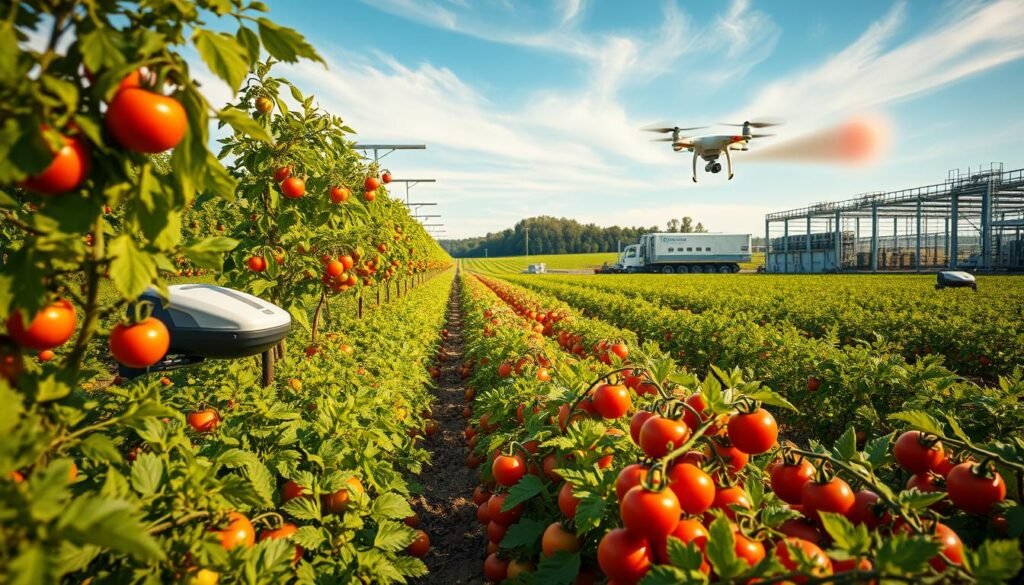
One of the most significant challenges in farming is maintaining soil health. Intelligent systems now provide precise insights into soil nutrient levels, allowing you to adjust fertilisation rates effectively. For example, AI in tomato farming has enabled farmers to reduce fertiliser waste by up to 50% while improving plant health.
These systems combine satellite imagery, local weather data, and farm-specific information to deliver tailored recommendations. This ensures that resources are used efficiently, benefiting both the environment and your bottom line.
Early Pest and Disease Detection Capabilities
Early detection of pests and disease is crucial for protecting your crop. Advanced technologies can identify issues before they spread, reducing the need for chemical interventions. For instance, systems like JEEVN AI offer pest forecasting with over 90% accuracy, helping you take proactive measures.
By integrating these solutions, you can minimise losses and ensure healthier plants. This not only boosts yield but also supports sustainable farming practices.
“The integration of intelligent systems in agriculture is revolutionising how we manage crops, ensuring both productivity and sustainability.”
| Feature | Benefit |
|---|---|
| Soil Nutrient Analysis | Optimises fertiliser use, improves plant health |
| Pest Forecasting | Reduces chemical usage, minimises crop loss |
| Customised Recommendations | Enhances resource efficiency, boosts yield |
Adopting these solutions can help you overcome the challenges of modern farming. By making informed decisions, you can maximise your crop’s potential and ensure a sustainable future for your farm.
Innovative Technologies and Their Impact on Agriculture
Modern agriculture is embracing groundbreaking technologies to tackle its most pressing challenges. From satellite intelligence to robotics, these advancements are reshaping how farmers manage their land and crops. By integrating these solutions, you can optimise resources, improve efficiency, and ensure sustainable growth.
Harnessing Satellite Intelligence and Weather Data
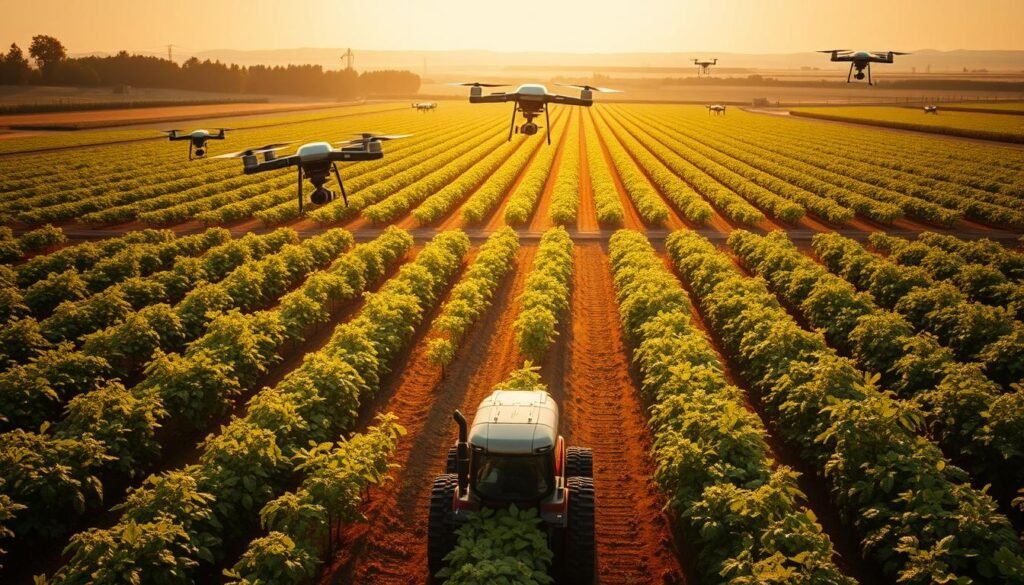
Satellite intelligence provides a comprehensive view of farm conditions, helping you monitor soil health and crop growth. By analysing vegetation indices like NDVI, you can assess plant vigour and detect issues early. This data is crucial for making informed decisions about fertiliser application and irrigation schedules.
Weather data plays a vital role in optimising water management. By predicting rainfall and temperature patterns, you can adjust irrigation to reduce waste. This ensures your crops receive the right amount of water, even in unpredictable climates.
Drones and Ground-Based Robots for Precision Farming
Drones are revolutionising crop monitoring by capturing high-resolution images of your fields. This reduces the need for manual inspections and saves time. With real-time data, you can identify pest infestations or nutrient deficiencies before they escalate.
Ground-based robots are equally transformative. They can perform tasks like planting, weeding, and harvesting with precision. This minimises labour costs and ensures consistent crop quality. Together, these technologies enhance operational efficiency and support sustainable practices.
| Technology | Benefit |
|---|---|
| Satellite Intelligence | Monitors soil health and crop growth |
| Weather Data | Optimises irrigation and water use |
| Drones | Provides real-time crop monitoring |
| Ground-Based Robots | Reduces labour and improves precision |
By adopting these technologies, you can overcome challenges like climate variability and soil degradation. They empower you to make data-driven decisions, ensuring healthier crops and higher yields. The future of farming lies in integrating these innovations for sustainable growth.
Conclusion
Modern advancements are reshaping how you manage your crop and resources. By leveraging data-driven insights, you can enhance yield and ensure healthier plant growth. Efficient management of soil, water, and disease challenges is now more achievable than ever.
Real-world examples from Indiana and Florida highlight the transformative power of innovative technology. These solutions not only improve efficiency but also support sustainable practices. Making informed decisions based on accurate data can significantly boost your farm’s productivity.
Looking ahead, the future of tomato cultivation lies in integrating these cutting-edge methods. By adopting such practices, you can stay ahead of challenges and ensure long-term success. Explore how JEEVN AI is revolutionising precision agriculture for tomato growers.
Thank you for engaging with this content. For more detailed insights, consider subscribing to our resources. Your journey towards smarter farming starts here.
FAQ
How does AI improve soil health in tomato farming?
AI analyses soil data to provide insights on nutrient levels and moisture content. This helps you make informed decisions about fertilisers and irrigation, ensuring optimal soil health for better crop growth.
Can AI help detect pests and diseases early?
Yes, AI-powered systems use image recognition and data analysis to identify signs of pests or diseases before they spread. Early detection allows you to take timely action, reducing crop loss and improving yield.
What role do drones play in precision farming?
Drones equipped with sensors and cameras monitor crop conditions from above. They provide detailed data on plant health, water usage, and pest activity, enabling you to manage resources more efficiently.
How does weather data integration benefit tomato growers?
AI systems combine satellite intelligence and weather forecasts to predict climate conditions. This helps you plan irrigation schedules and protect crops from adverse weather, enhancing overall productivity.
Are there real-world examples of AI improving tomato farming?
Yes, Indiana has successfully used integrated AI solutions to boost crop yields. Similarly, Florida has implemented AI for water management, optimising irrigation and reducing resource wastage.
Can AI reduce the need for manual labour in farming?
Absolutely. AI-driven tools automate tasks like monitoring, data collection, and even harvesting. This reduces the reliance on manual labour, saving time and improving efficiency.
How does AI contribute to sustainable farming practices?
AI promotes sustainability by optimising resource use, reducing chemical inputs, and minimising waste. It helps you adopt eco-friendly practices while maintaining high-quality production.
What are the challenges of adopting AI in tomato farming?
Initial costs and the need for technical expertise can be barriers. However, the long-term benefits, such as increased yield and reduced resource use, often outweigh these challenges.
How can AI improve decision-making for tomato growers?
AI provides accurate, data-driven insights on crop health, soil conditions, and weather patterns. This enables you to make informed decisions, improving overall farm management and productivity.
What is the future of AI in tomato farming?
The future looks promising, with advancements in satellite intelligence, robotics, and predictive analytics. These innovations will further enhance efficiency, yield, and sustainability in tomato cultivation.
Source Links
- AI in Agriculture: Revolutionizing Crop Management | Keymakr
- Artificial Intelligence Tools for the Agriculture Value Chain: Status and Prospects
- 20 AgTech Startups Revolutionizing Agriculture with AI
- Classification of Tomato Harvest Timing Using an AI Camera and Analysis Based on Experimental Results
- Internet of Things (IoT) and Artificial Intelligence (AI) in Agriculture: Applications for Sustainable Crop Protection
- The Economic Impacts of AI-Enabled Precision Agriculture and boosting Productivity and…
- AI-ML Applications in Agriculture and Food Processing
- Transforming Pest Management with Artificial Intelligence Technologies: The Future of Crop Protection – Journal of Crop Health
- How Satellite Technologies Reduce Costs for Agrochemicals and Fertilizers
- Frontiers | Leveraging deep learning for plant disease and pest detection: a comprehensive review and future directions
- News
- Bioeconomy News Archives | Industry Intelligence Inc.
- Social Media Posts for Emory University
- AI
- Enhanced recognition and counting of high-coverage Amorphophallus konjac by integrating UAV RGB imagery and deep learning – Scientific Reports

Dave is a scientific writer, and urban gardening enthusiast specializing in indoor tomato cultivation. At TomatoAnswers.com, he shares eco-friendly, data-driven methods to help city gardeners grow healthy, high-yield tomatoes in limited spaces. His work bridges medical science and modern agri-tech, inspiring sustainable, tech-enhanced urban gardening.