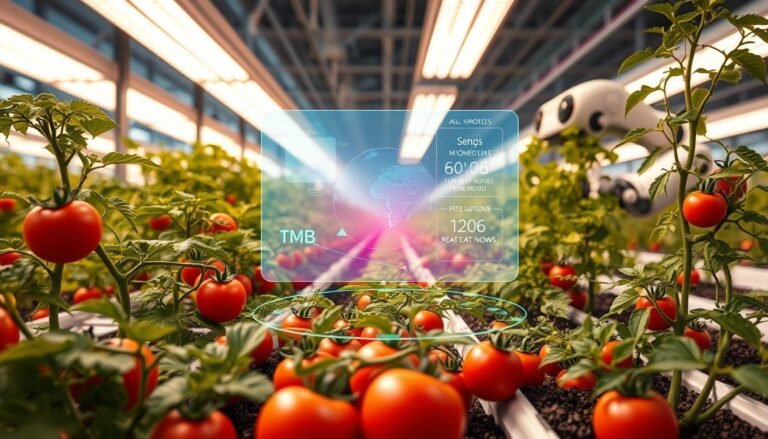
Did you know that global tomato production exceeds 1.8 million tons annually, making it the most produced crop worldwide? Yet, despite its popularity, cultivating this plant efficiently remains a significant challenge. Traditional methods often struggle to adapt to varying environmental conditions, which can impact both yield and quality.
Enter advanced technologies that are transforming agriculture. By integrating sensors and customised algorithms, growers can now monitor and optimise conditions like temperature, light, humidity, and CO2 levels in real-time. This approach not only enhances production but also addresses the shortage of skilled personnel in the field.
Take, for example, the Autonomous Greenhouse Challenge organised by Wageningen University & Research. Teams like ‘The Automatoes’ have demonstrated how machine learning can manage greenhouses remotely, achieving impressive results. This innovation is paving the way for sustainable and efficient farming practices.
Key Takeaways
- Global tomato production faces challenges due to environmental variability.
- Sensor technology and algorithms are revolutionising crop management.
- Remote monitoring systems address the lack of skilled agricultural workers.
- Real-time data optimises growing conditions for better yield and quality.
- Initiatives like the Autonomous Greenhouse Challenge showcase the potential of advanced tools.
The Role of AI in Modern Tomato Cultivation
Modern agriculture is embracing innovative tools to tackle the complexities of crop cultivation. Among these, advanced sensor technologies and remote management systems are playing a pivotal role. These tools enable growers to monitor and adjust environmental conditions in real-time, ensuring optimal growth for each plant.
Emerging Sensor Technologies and Remote Management
Emerging sensor technologies are revolutionising how we collect and analyse environmental data. These sensors monitor critical parameters like temperature, humidity, and soil moisture. This continuous data collection allows for precise adjustments, enhancing both yield and quality.
Remote management systems take this a step further. Teams can now control greenhouse settings without being physically present. For instance, the Autonomous Greenhouse Challenge demonstrated how algorithms could manage greenhouses remotely, achieving impressive results.
How Data and Algorithms Optimise Greenhouse Conditions
Computers and algorithms work together to ensure each plant receives the ideal conditions for growth. By analysing real-time data, these systems adjust factors like light and CO2 levels. This not only boosts production but also addresses challenges like resource efficiency.
Combining traditional horticultural expertise with machine learning creates a powerful synergy. For example, the YOLOv5 algorithm achieved a detection accuracy of 94.1%, showcasing the potential of these technologies. This integration ensures high-quality production while minimising waste.
- Efficient resource use: AI optimises water and electricity consumption, reducing costs and environmental impact.
- Continuous monitoring: Sensors provide accurate, real-time data, enabling proactive adjustments.
- Collaborative research: Partnerships between institutions and industry drive innovation in agriculture.
AI climate-based tomato growing
Remote control and machine learning are transforming the way we manage crops. These technologies allow growers to monitor and adjust conditions without being physically present. This reduces the need for onsite intervention and ensures optimal growth for each plant.

Machine learning integration supports real-time adjustments in irrigation, lighting, and nutrient delivery. By analysing data from sensors, these systems can make precise changes to enhance both yield and quality. For example, teams from TU Delft have demonstrated how algorithms can manage greenhouses remotely, achieving impressive results.
Addressing Crop Challenges with Advanced Systems
Advanced systems are designed to identify and resolve specific crop challenges. These include issues like nutrient deficiencies, pest infestations, and environmental stress. By using comprehensive data from sensors, machine learning algorithms can predict and address these problems before they escalate.
Collaborative efforts between universities and industry players drive the development of these technologies. For instance, research from Wageningen University & Research highlights the importance of integrating horticultural knowledge with digital tools. This synergy ensures high-quality production while minimising waste.
- Efficient resource use: Systems optimise water and electricity consumption, reducing costs and environmental impact.
- Continuous monitoring: Sensors provide accurate, real-time data, enabling proactive adjustments.
- Collaborative research: Partnerships between institutions and industry drive innovation in agriculture.
These advancements not only improve outcomes in complex growth environments but also pave the way for sustainable farming practices. By integrating both digital and model-based approaches, growers can achieve enhanced production quality and efficiency.
Integrating Cutting-edge Technologies for Sustainable Tomato Production
Sustainable farming practices are evolving with the integration of cutting-edge technologies. These innovations are not only enhancing crop quality but also addressing challenges like disease detection and resource efficiency. By leveraging advanced tools, growers can ensure healthier plants and more reliable production.

Innovative Disease Detection and Digital Sensing
One of the most significant advancements is the use of digital sensing for early disease detection. Projects like TomatoGuard utilise graphene-based sensor arrays to monitor plant health. This system can identify issues like red spider mites before they escalate, reducing the need for pesticides.
These sensors provide real-time data, allowing growers to take proactive measures. This not only improves crop quality but also minimises environmental impact. By adopting such technologies, you can ensure a more sustainable approach to farming.
Collaborative Research and Future-Proof Solutions
Collaboration between academic institutions and industry leaders is driving innovation. For instance, the partnership between The UK Agri-Tech Centre, Altered Carbon, and Fargro Ltd has led to the development of robust solutions. These initiatives focus on creating scalable systems that can be adapted to other crops.
Such research ensures that the technologies being developed are future-proof. They are designed to meet the evolving needs of modern agriculture, offering long-term benefits for growers and the environment alike.
Leveraging Robotics and Algorithmic Enhancements
Robotics and algorithms are playing a crucial role in fine-tuning greenhouse conditions. Automated systems can adjust factors like light, temperature, and humidity with precision. This ensures optimal growth conditions for each plant, enhancing both yield and quality.
These advancements also contribute to resource efficiency. By reducing waste and optimising inputs, you can achieve a healthier bottom line while supporting sustainable practices. For more insights into how these technologies are transforming agriculture, explore this detailed study.
Integrating these technologies into your farming practices can lead to significant improvements. From early disease detection to resource optimisation, the benefits are clear. By embracing innovation, you can ensure a more sustainable and productive future for your crops.
Conclusion
Advanced tools and systems are reshaping how we approach crop cultivation. By integrating remote management, enhanced sensor technology, and machine learning, you can optimise conditions for healthier plants and better yields. These solutions address key challenges, ensuring optimal growth stages and efficient resource use.
Collaborative research plays a vital role in developing sustainable, future-proof systems. Partnerships between institutions and industry leaders drive innovation, creating scalable solutions for modern agriculture. This approach not only improves monitoring but also enhances production outcomes.
Looking ahead, the goal is to integrate these technologies for long-term quality and sustainability. By adopting these tools, you can overcome challenges and achieve consistent results. Explore how these advancements can be adapted to your practices for a more efficient and productive future.
For further insights, consider this study on the impact of environmental changes on crop distribution and management strategies.
FAQ
How does technology improve tomato cultivation?
Technology enhances cultivation by using sensors and algorithms to monitor and adjust greenhouse conditions. This ensures optimal growth and quality for the crop.
What role does machine learning play in agriculture?
Machine learning analyses data to predict and address issues like disease or environmental changes. It helps growers make informed decisions for better production.
Can advanced systems help with crop challenges?
Yes, advanced systems detect problems early and provide solutions. They improve plant health and yield by addressing issues like pests or soil quality.
How do sensors benefit greenhouse management?
Sensors monitor factors like temperature, humidity, and light. This data allows for precise control, creating the ideal environment for growth.
What is the goal of integrating robotics in farming?
Robotics streamline tasks like planting and harvesting. They increase efficiency and reduce labour, making production more sustainable.
How does research contribute to future-proof solutions?
Research develops innovative tools and methods. These advancements ensure farming practices remain effective and adaptable to changing conditions.
Why is monitoring important in modern agriculture?
Monitoring tracks plant health and environmental factors. It helps growers identify and resolve issues quickly, ensuring consistent quality and yield.
Source Links
- Classification of Tomato Harvest Timing Using an AI Camera and Analysis Based on Experimental Results
- Internet of Things (IoT) and Artificial Intelligence (AI) in Agriculture: Applications for Sustainable Crop Protection
- Transforming Pest Management with Artificial Intelligence Technologies: The Future of Crop Protection – Journal of Crop Health
- Design of tomato picking robot detection and localization system based on deep learning neural networks algorithm of Yolov5 – Scientific Reports
- AI
- Smart Sensors and Artificial Intelligence Driven Alert System for Optimizing Red Peppers Drying in Southern Italy
- Technological Innovations in Urban and Peri-Urban Agriculture: Pathways to Sustainable Food Systems in Metropolises
- Frontiers | Leveraging deep learning for plant disease and pest detection: a comprehensive review and future directions
- How Satellite Technologies Reduce Costs for Agrochemicals and Fertilizers
- Plant breeding for CEA: Can innovation be fast-tracked to boost yields and quality?
- Enhanced recognition and counting of high-coverage Amorphophallus konjac by integrating UAV RGB imagery and deep learning – Scientific Reports

Dave is a scientific writer, and urban gardening enthusiast specializing in indoor tomato cultivation. At TomatoAnswers.com, he shares eco-friendly, data-driven methods to help city gardeners grow healthy, high-yield tomatoes in limited spaces. His work bridges medical science and modern agri-tech, inspiring sustainable, tech-enhanced urban gardening.